Why Your Brain Prefers Folders Over Search (and What AI Gets Wrong)
Search feels powerful, but your brain still craves spatial navigation. Neuroscience shows why folders keep winning—and what AI needs to learn.
You have the world's most powerful search at your fingertips. Yet you still click through folders to find your files.
This isn't irrational behavior. Your brain evolved for millions of years to navigate physical space. Search engines appeared 30 years ago.
The navigation paradox
Modern search engines can index millions of files in milliseconds. They understand natural language. They predict what you want before you finish typing.
Yet research shows people navigate folder hierarchies 56-68% of the time . Search accounts for only 4-15% of file retrievals . Users often try search only after folder navigation fails.
This preference puzzled researchers for decades. Search appears faster and more flexible. Navigation requires building folder structures upfront and remembering where files live.
The explanation lies in your skull.
What your brain does during navigation vs. search
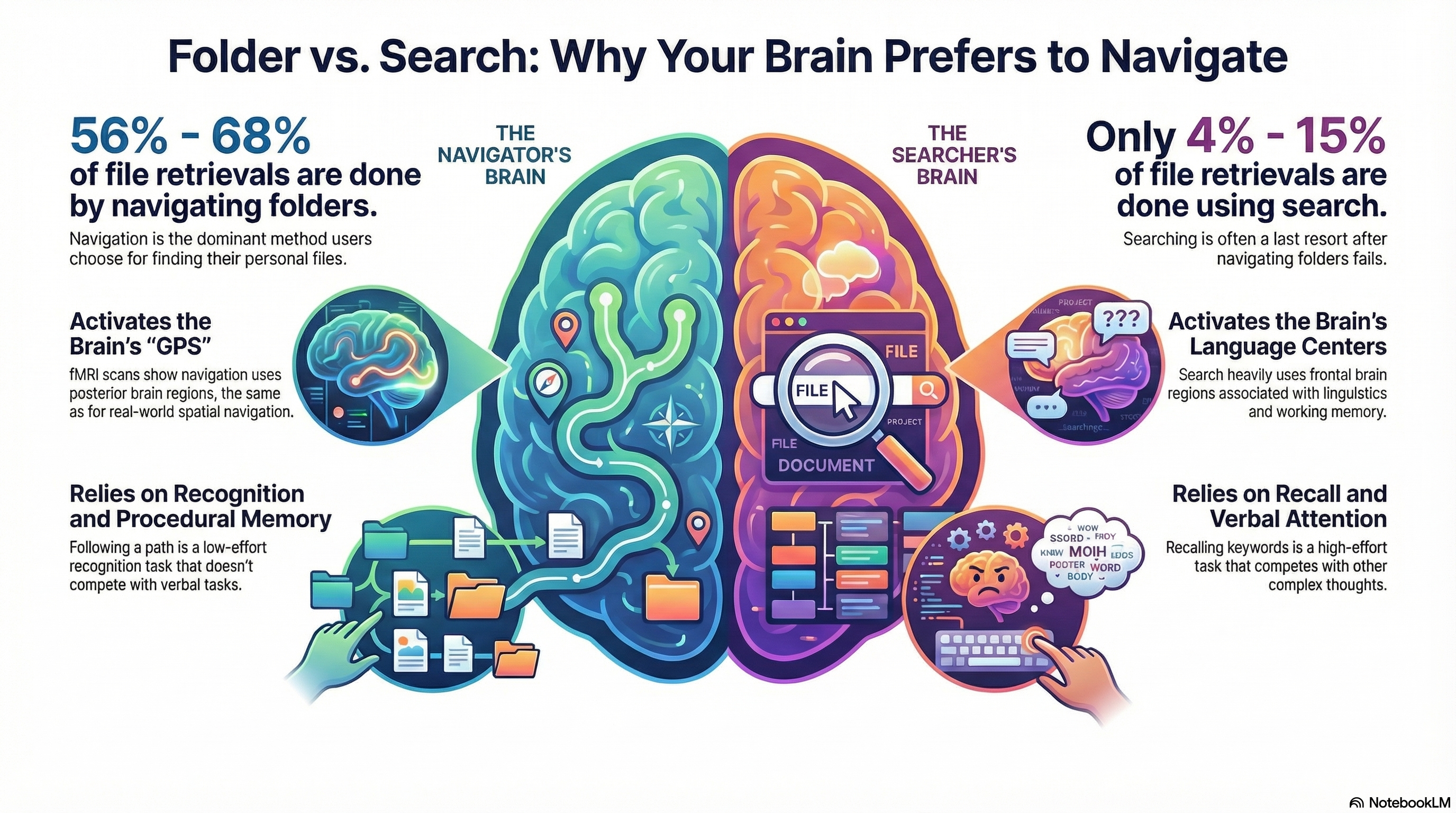
An fMRI study by Benn et al. scanned people's brains while they retrieved files using both methods. The results revealed something striking.
Navigation activates your .
Search activates your left frontal regions, particularly .
This distinction matters because you're usually doing something else when you need a file. You're writing an email, preparing a presentation, or debugging code. These tasks already demand .
Navigation runs on autopilot. Search competes for the same mental resources you need for your actual work.
The cognitive advantages stack up
A dual-task study confirmed this difference. Researchers asked people to memorize words while retrieving files. Participants remembered significantly more words when navigating than when searching.
Navigation requires less verbal attention than search. The difference persisted even when researchers controlled for retrieval speed.
Three cognitive advantages explain why folders win:
Consistency: The same path leads to the same file every time. This predictability confirms expectations and reduces .
: You recognize folder names as you browse. Search requires recalling specific terms to formulate a query.
: Navigation becomes muscle memory, like riding a bike or typing. Search relies on —knowing specific facts about files.
Your brain converts repeated navigation paths into automatic procedures. Click Documents. Click Projects. Click Client Work. Your hands execute the sequence while your mind stays focused on the task.
The paperless office that never arrived
The same instinct shows up in our stubborn attachment to paper. Paper needs no power, holds remarkable resolution, and—the part that matters here—is spatial: you know a page by where it sits. In , Sellen and Harper made the case that the goal was never zero paper—it was tools that respect why paper works. Same lesson as folders: don't demand people abandon a spatial habit that's doing real cognitive work.
We carve out territory, even on screens
When people gather around a physical table, they partition it without thinking: your space in front of you, shared space in the middle, a spot for the things not in use. This tabletop territoriality is deeply ingrained—and, remarkably, it persists on digital surfaces. Early research into collaborative tabletop computers found people still respecting invisible boundaries no one drew. The design lesson is the same one again: accommodate the spatial instinct instead of fighting it—color-code documents by owner, say, rather than papering the screen with boundary lines.
What AI gets wrong
Modern AI systems assume search superiority. architectures, , and semantic search all push the same paradigm: Tell us what you want and we'll find it.
This approach misses the neuroscience. Search doesn't fail because it's slow or inaccurate. Search fails because it interrupts your thinking.
When you pause your work to formulate a search query, you're pulling cognitive resources away from your primary task. You shift from writing or designing into a linguistic retrieval mode. Your brain .
Navigation lets you grab files while staying mentally engaged with your work. The retrieval becomes background processing.
AI assistants that optimize for search speed miss this fundamental insight. Faster search is still search. It still competes with the linguistic parts of your brain that you need for everything else.
What a navigation-first tool actually does
The neuroscience isn't just an interesting aside—it's a spec. If navigation runs in the background and search competes with your work, a tool built for the brain should keep you navigating as long as it can and only fall back to language when it has to. In practice that's three concrete moves.
Keep the structure visible and stable, so the same file lives at the end of the same clicks every time—predictability is the whole point of the parahippocampal route, and a layout that reshuffles itself throws it away. Speed navigation up from inside the structure rather than replacing it: surface the folder you open at this hour or the file you touched yesterday, making the click faster without turning it into a search box. And when you genuinely need to filter, do it by recognition, not recall: —pick a rough time range, a person, a topic, in any order, and watch the set shrink—instead of demanding the keyword you'd have to remember first.
I built a prototype along exactly these lines for my 2018 master's thesis, called . You could narrow by temporal, social, or thematic dimensions in any order, and it scored a —above the 68 average—precisely because it never made you leave the navigation mode your brain prefers.
The future isn't search-only
The tech industry spent two decades assuming better search would replace manual organization. . Desktop search became instant. AI can now understand natural language queries.
Yet people still organize files into folders. They still navigate hierarchies. They still prefer clicking through paths they recognize.
This behavior isn't a failure of user education. It's not resistance to change. It's your parahippocampal gyrus doing what evolution designed it to do.
The future of personal information management isn't search-only or navigation-only. It's interfaces that work with your brain's architecture instead of against it.
AI has made search extraordinarily powerful. The next breakthrough will come from systems that understand when navigation is the better tool—and why your brain prefers the path you can see.